Using AI on YouTube Without Turning Your Channel Into Slop
The uncomfortable pattern I have watched for the last couple of years is this: most people only learn after it has cost them something.
Not because they are foolish. Because the warning always arrives while the shortcut is still working. Somebody publishing forty near-identical machine-made videos a week is, for a while, getting more views than the person publishing one careful video. Advice to slow down sounds like envy at that point. Then something changes — a policy update, a review, a shift in what gets recommended — and a year of work is suddenly worth nothing.
I am not against these tools. I use them daily. After nine years of building channels for English-speaking audiences, I think they are the biggest advantage a small creator has ever been handed. What matters is which bet you make with them.
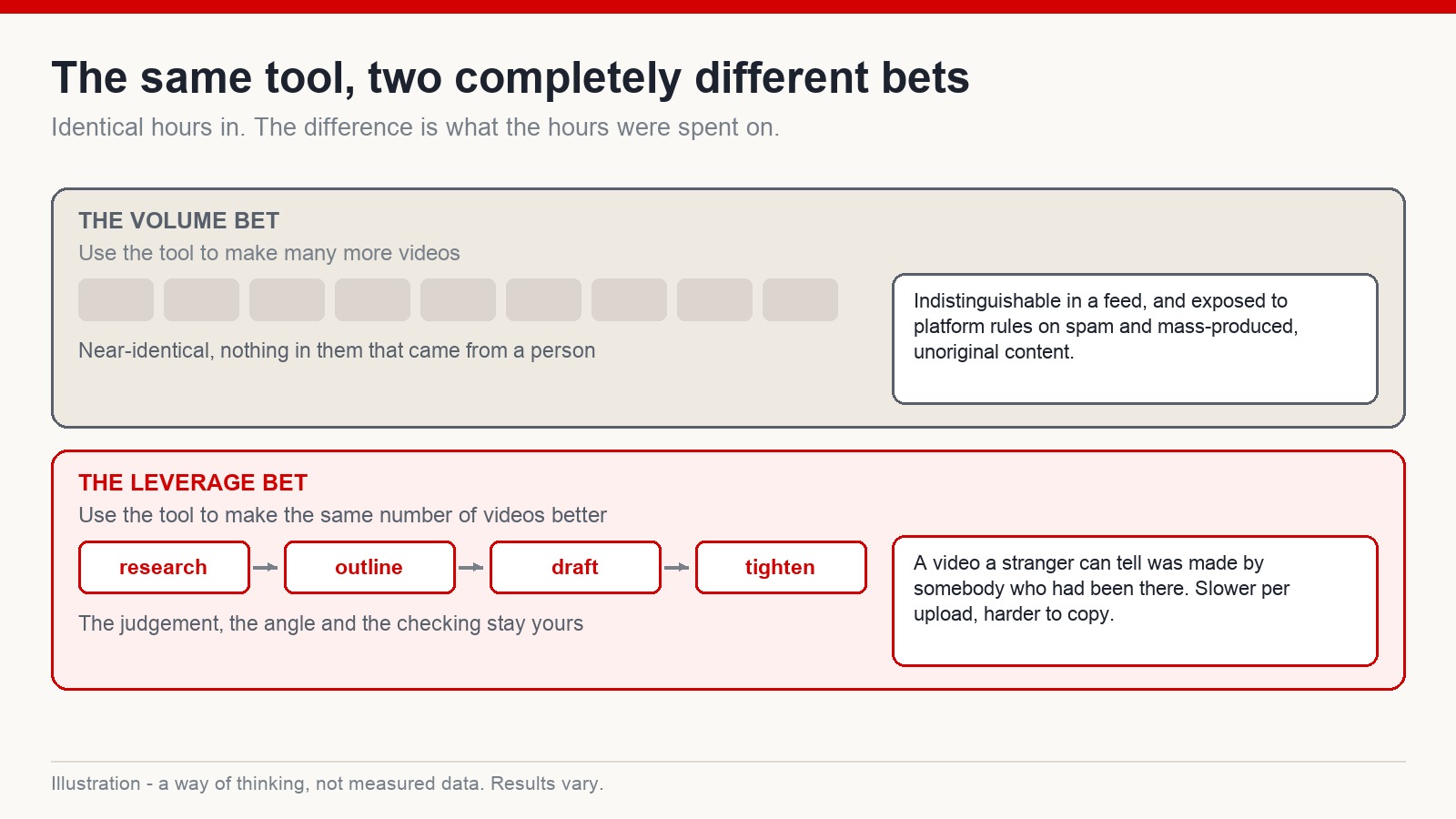
The same tool, two completely different bets
The volume bet says: use the tool to publish far more. The output is near identical, there is nothing in it that came from a person, and it is indistinguishable from thousands of other channels running the same play. It is also directly exposed to platform rules about spam, repetitious content and mass-produced material — rules that get enforced in waves rather than continuously, which is exactly why they feel survivable right up until they are not.
The leverage bet says: use the tool to make the same number of videos, better. It reads sources faster than you can, turns your notes into an outline, drafts a section you would have stared at for an hour, and takes the dull parts of production off your hands. The judgement, the angle and the fact-checking stay yours.
Identical hours in. What differs is what the hours bought: a pile of interchangeable uploads, or a video a stranger can tell was made by someone who had actually been there.
Where the tool helps, and where it must not decide
The line is not about how much you use it. It is about which job you hand over.
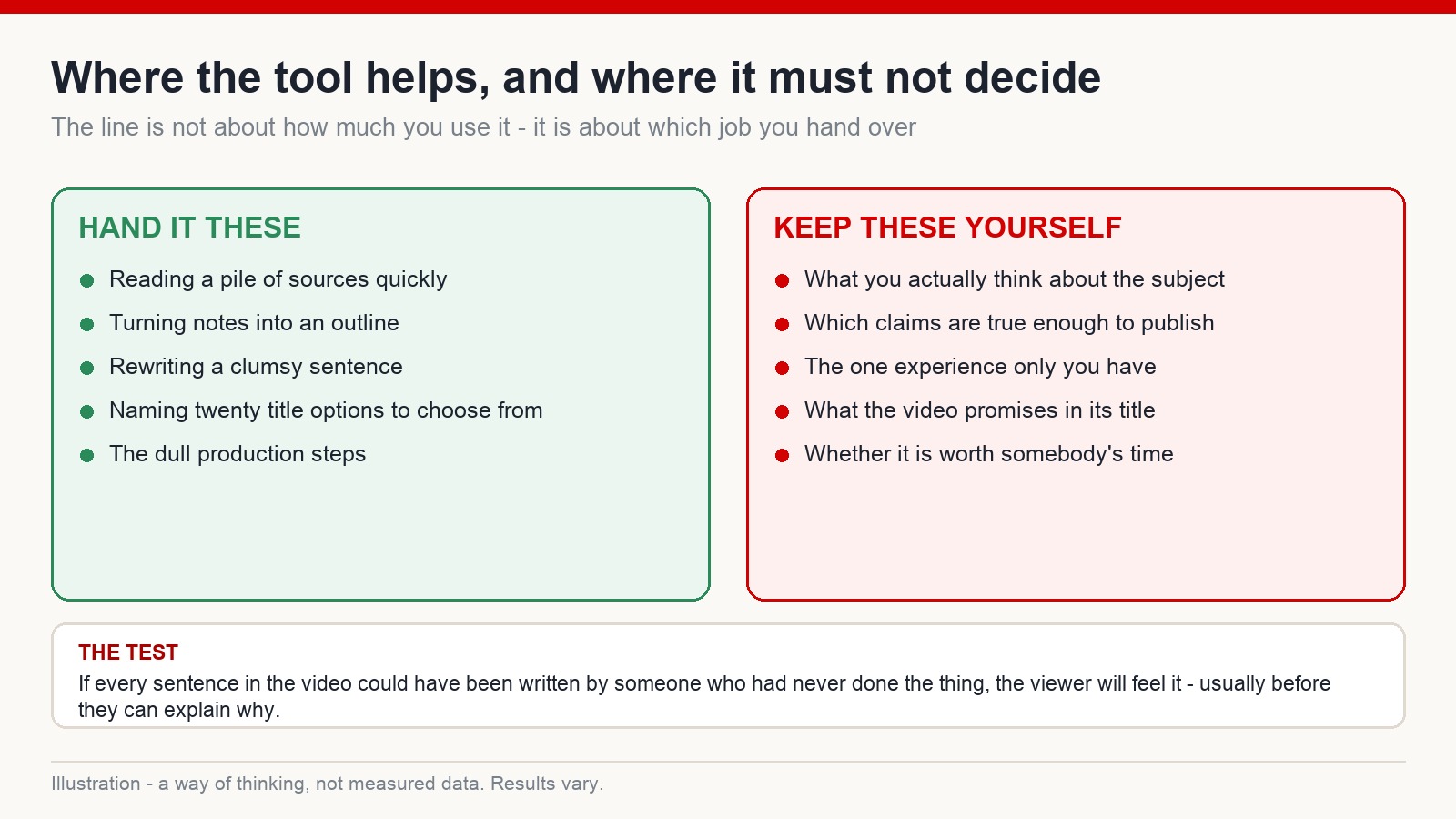
Hand it these without hesitation: reading a pile of sources quickly, turning notes into an outline, rewriting a clumsy sentence, generating twenty title options so you can choose rather than defend your first, and the repetitive production steps that make you dread your own workflow.
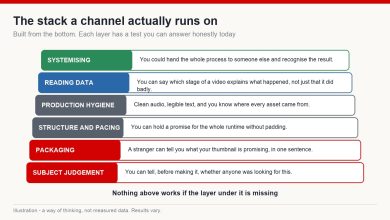
Keep these yourself: what you actually think about the subject. Which claims are solid enough to publish. The one experience only you have. What the video promises in its title. And whether the whole thing is worth somebody’s time at all.
The test is blunt. If every sentence in the video could have been written by someone who had never done the thing, the viewer feels it — usually before they can explain why. They just do not come back.
The trap is “fast”, not the technology
When people arrive wanting money first and a channel second, the shortcuts become irresistible in a specific order. They see somebody publishing at industrial volume and copy the volume. They see a machine voice reading somebody else’s article and copy that. They see a screenshot of a payout and feel behind. They see a channel doing well on thin content and conclude that is the road.
What they cannot see from outside is the other half of the picture: whether that channel can survive a review, whether it is one policy change from nothing, whether anybody involved has any idea why it worked and could do it again. A screenshot shows the good month. It never shows the risk carried underneath it.
And there is a quieter cost that gets ignored. A channel built on interchangeable content teaches you nothing transferable. When it stops working, you have no audience, no skill and no back catalogue — you have to start over from scratch, except now with less time and less optimism.
Five questions before you publish
This is the whole quality gate I use, and it takes about five minutes.
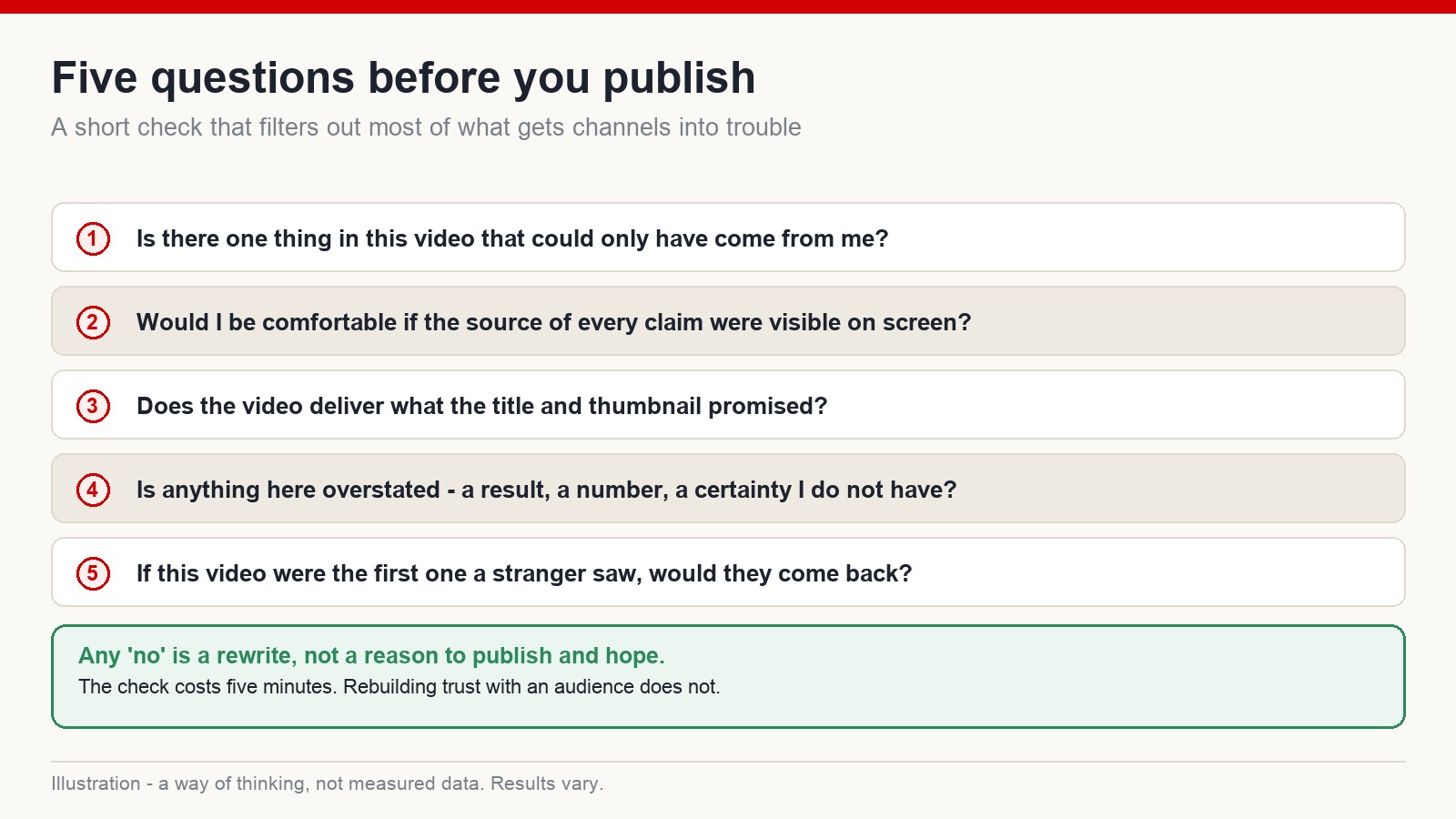
- Is there one thing in this video that could only have come from me?
- Would I be comfortable if the source of every claim were visible on screen?
- Does the video deliver what the title and thumbnail promised?
- Is anything here overstated — a result, a number, a certainty I do not actually have?
- If this were the first video a stranger saw, would they come back for a second?
Any “no” is a rewrite, not a reason to publish and hope. The check costs five minutes. Rebuilding trust with an audience does not.
Question four deserves extra weight in anything touching money, health or safety. Overstating a result in those areas is where creators do real damage, and it is also where platforms are least forgiving. “Some people report this” is a very different sentence from “this works”, and only one of them is honest most of the time.
Doing it properly does feel slower, and that is real
I want to be straight rather than encouraging here, because the honest version is more useful.
If you take the careful path, there will be months where you watch thinner channels move faster than yours and it will sting. That is not a motivational obstacle to push through with the right attitude; it is simply true, and pretending otherwise is how people end up feeling defective when they are actually doing fine.
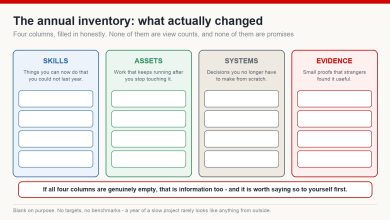
What I can say is what the careful path buys, and it is not a guarantee. A video with something real in it can keep finding new viewers for years, because the problem it addresses does not expire. The skills compound whether or not any single video works. And you are not carrying the low-level anxiety of a channel that could disappear over a rule change you have already read.
What it does not buy is a particular outcome. Results vary enormously between creators doing similar work, platform behaviour changes without notice, and nobody — including me — can tell you what a given channel will earn. Treat anyone who does with suspicion, especially when a course is attached to the claim.
What I actually think now
For a long time I believed that if I said it clearly enough and often enough, people would avoid the expensive mistakes. That was naive. Some lessons are only available at full price, and no amount of warning substitutes for the experience of losing something.
So I have stopped trying to talk anyone out of the fast version. What I can do is be specific with the people who want the durable version: use the tools aggressively for research and production, keep your judgement and your experience firmly in the middle of the work, run the five questions before you publish, and accept that the compounding is slow and mostly invisible while it is happening.
The technology is not the thing that ends channels. Handing it the one job that made your channel worth watching is.
Frequently asked questions
Will using AI get my YouTube channel demonetised?
Using these tools is not itself a problem, and plenty of legitimate channels use them throughout production. The risk sits with mass-produced, repetitious or unoriginal content that adds nothing of the creator’s own — that is what platform policies target, and the specifics change over time, so read the current rules rather than trusting a summary.
What counts as AI slop?
Content produced in bulk with no original perspective, research or experience in it: a machine voice reading somebody else’s article over stock footage, near-identical uploads at high volume, videos that exist to occupy a slot rather than to answer anything. The giveaway is that nothing in the video required the person who made it.
Can a faceless channel still be original?
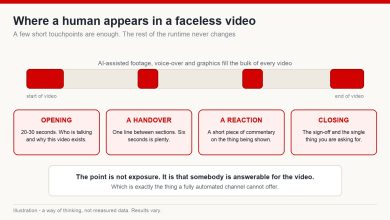
Yes, and most of my own work is faceless. Faceless describes what is on screen, not what is in the script. Original research, a specific point of view and first-hand experience all survive perfectly well behind a voice track and graphics.
Is it better to publish fewer, better videos?
For most people building something durable, yes — but with a floor. Publish at a pace you can hold in a bad week and use the extra time to improve one thing per upload. Very low volume has its own problem: too little data to learn from.
How do I use AI tools without losing my own voice?
Decide the angle before you open the tool, write the parts that come from your own experience yourself, and use it for research, structure and cleanup rather than for opinions. If you cannot point to the sentence that only you could have written, you have handed over too much.
If you want a structured way to build a durable channel for an English-speaking audience, that is what I teach at mmoyoutube.com.